From Marketing Funnels to Agentic Ecosystems: The Digital Reset
Introduction
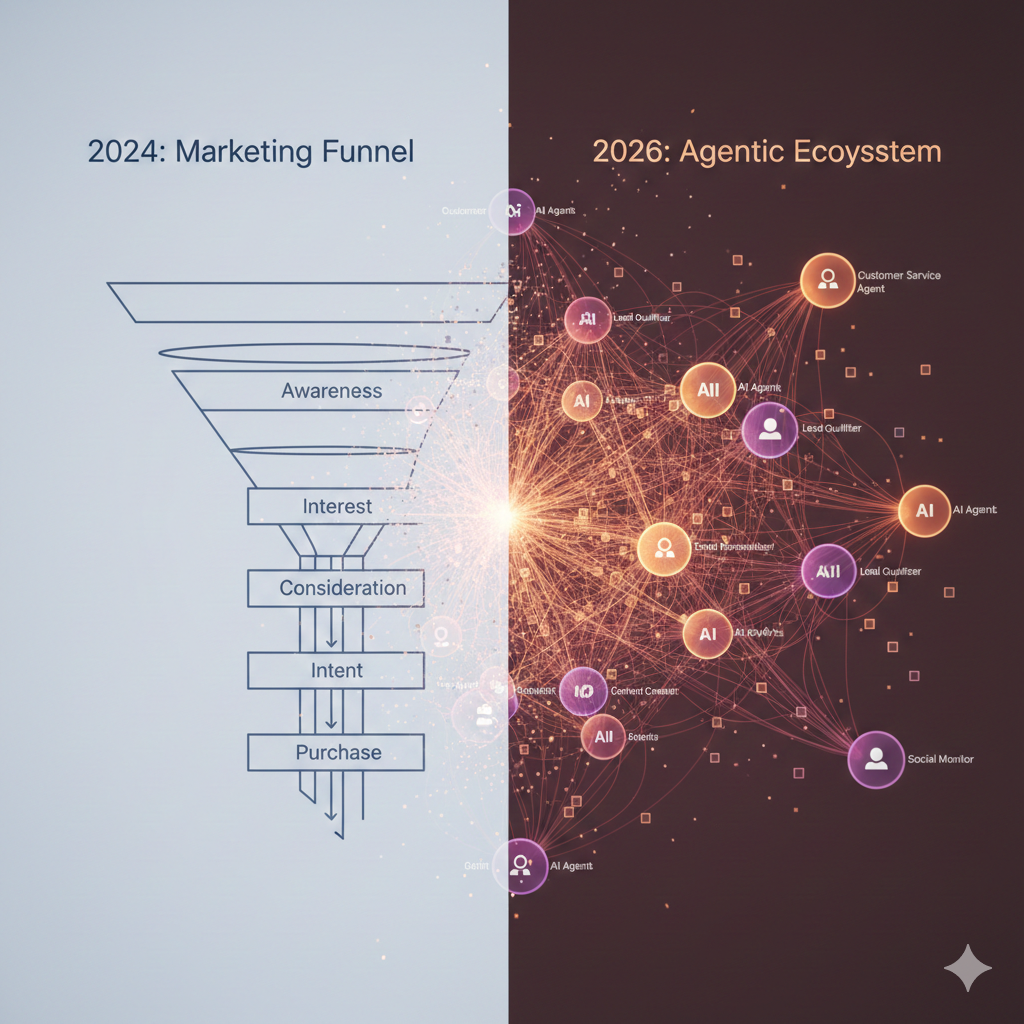
For years, digital growth followed a predictable structure—funnels, touchpoints, hand-offs, dashboards, and approvals. However, that structure is quietly breaking down. Agentic ecosystems in digital marketing are reshaping how brands attract, convert, and retain customers by replacing fragmented funnels with intelligent, self-directed systems.
Unlike traditional automation, this shift represents something far deeper. Instead of executing isolated tasks, AI agents now manage entire journeys. As a result, the gap between first interaction and final invoice continues to shrink.
Simply put, this is not an upgrade.
Rather, it is a reset.
When Agents Own the Entire Customer Journey
Imagine a prospect landing on your website.
Almost instantly, their intent is understood. Meanwhile, content adapts in real time. Shortly after, a personalized offer appears. Eventually, the deal closes—and the invoice is generated.
Throughout this journey, no human hand-offs slow things down.
This is the promise of agentic ecosystems in digital marketing, where interconnected agents manage the full lifecycle while humans focus on strategy and relationships.
Why Traditional Marketing Funnels Are No Longer Enough
Marketing funnels were built for a slower, more linear world. At the time, customer behavior followed predictable steps. Today, however, buyers move fluidly across platforms, devices, and channels.
Because of this shift, funnels struggle to keep up.
More importantly, funnels rely on:
Manual decision-making
Department-based ownership
Delayed responses
Static segmentation
Consequently, friction builds at every stage. Leads stall, data gets lost, and personalization arrives too late.
In contrast, agentic ecosystems respond instantly.
What Are Agentic Ecosystems in Digital Marketing?
Agentic ecosystems in digital marketing are networks of AI-powered agents designed to operate autonomously while working toward a shared business objective.
Each agent has a specific role. For example:
A content agent adapts messaging
A lead agent qualifies prospects
A pricing agent adjusts offers
A retention agent predicts churn
Together, these agents collaborate continuously. As a result, marketing becomes adaptive rather than reactive.
Instead of waiting for instructions, agents initiate actions based on live data.
From First Touch to Final Invoice — No Human Hand-Offs
Traditionally, marketing passes leads to sales. Sales then hands off to operations, which eventually passes data to finance. Unfortunately, every hand-off creates friction.
Agentic ecosystems eliminate these gaps.
Because context travels with the customer, decisions happen faster. Moreover, intent remains intact across every interaction. Over time, this continuity creates smoother experiences and stronger relationships.
Ultimately, humans step in where they matter most—strategy, creativity, and trust.
The Strategic Advantage for Growth-Driven Brands
Brands adopting agentic ecosystems in digital marketing gain more than efficiency. They gain clarity.
Faster Decisions Without Chaos
Since agents operate continuously, actions happen in real time rather than in batches.
Personalization at Scale
Instead of fixed segments, messaging evolves based on behavior.
Lower Cost of Acquisition
As manual effort decreases, efficiency improves.
Better Customer Experience
Most importantly, journeys feel cohesive rather than fragmented.
How DigitalGoin Approaches Agentic Marketing
At DigitalGoin, we don’t believe AI should replace humans. Instead, we design systems that remove friction from growth.
Our approach to agentic ecosystems in digital marketing focuses on:
Strategy-first architecture
Clearly defined agent roles
Ethical and explainable AI
Seamless tool integration
As a result, brands move from tool overload to outcome-driven ecosystems.
(Internal link suggestions)
Digital Marketing Services
AI-Driven Growth Solutions
Conversion Rate Optimization
Common Myths About Agentic Ecosystems
Myth 1: Agentic systems remove human control
In reality, humans define goals and boundaries. Agents simply execute intelligently.
Myth 2: This only works for large enterprises
On the contrary, startups and mid-sized brands often benefit faster.
Myth 3: Agentic marketing is just automation
Automation follows rules. Agents make decisions.
FAQs
Q1.What industries benefit most from agentic ecosystems in digital marketing?
E-commerce, SaaS, education, healthcare, and service-based businesses see the fastest impact.
Q2.Is it expensive to implement an agentic ecosystem?
Initially, investment is required. However, efficiency gains often offset costs quickly.
Q3.Can agentic systems work with existing tools?
Yes. Most ecosystems enhance your current stack rather than replace it.
Q4.Is customer data secure in agentic ecosystems?
When designed properly, these systems offer better control and traceability.
Final Thoughts: The Digital Reset Has Already Started
https://digitalgoin.com/contact-us/Funnels taught us how to guide customers.
Agentic ecosystems in digital marketing, however, teach us how to understand them.
This shift is not about chasing trends. Instead, it reflects how growth truly happens today—through intelligence, continuity, and adaptability.
The brands that succeed won’t shout louder.
Rather, they will think faster while staying human.
If you’re ready to move beyond funnels, DigitalGoin is ready to build that future with you.
